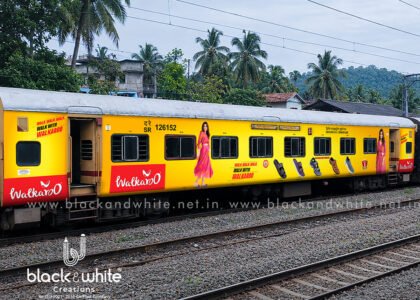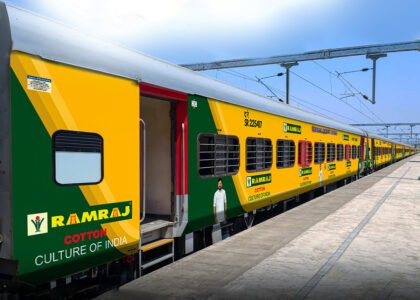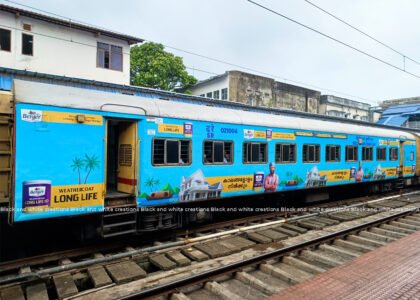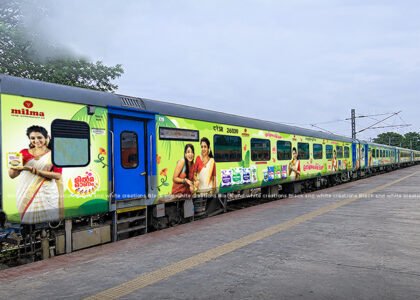

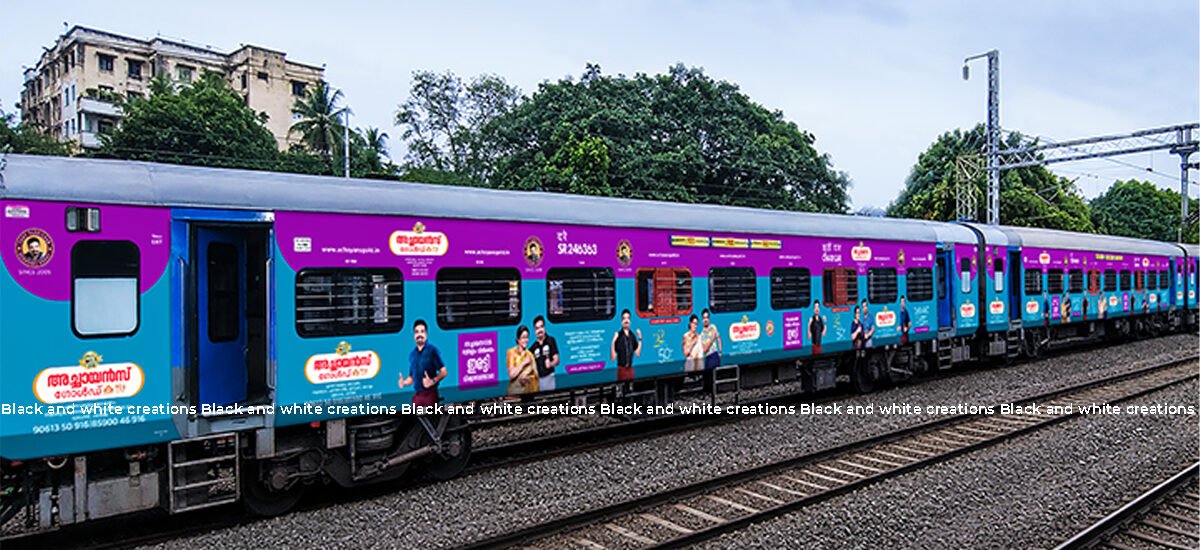
Train branding is a form of railway advertising that allows businesses to display their brand messages on eligible train coaches. For companies investing in outdoor and transit media, understanding the return on investment (ROI) of train branding is important for evaluating campaign performance and planning future budgets.
Unlike digital advertising, where clicks and conversions can often be tracked directly, train branding requires a broader measurement approach. Businesses can combine campaign delivery records, brand awareness research, digital analytics, lead data and sales indicators to understand the value of their investment.
This guide explains how to measure train branding ROI in India, which metrics to track and how to improve campaign measurement.
Train branding ROI measures the financial return attributable to a train advertising campaign relative to its total cost.
A commonly used formula is:
ROI (%) = [(Attributable return − Campaign cost) ÷ Campaign cost] × 100
For example, if a campaign costs ₹5,00,000 and generates ₹7,00,000 in attributable contribution, the illustrative ROI is 40%.
The example assumes that the ₹7,00,000 represents contribution attributable to the campaign, not simply total sales revenue. Businesses should account for relevant costs and avoid attributing unrelated sales to the advertising activity.
Brand awareness and recognition are also important outcomes, but they should be reported separately unless a credible method is used to estimate their financial value.
Measuring campaign performance helps businesses understand whether their advertising is aligned with their objectives.
A measurement plan can help advertisers assess:
The appropriate metrics depend on whether the campaign focuses on awareness, regional visibility, lead generation or sales support.
Before launching a train branding campaign, define what success means for your business.
Possible objectives include increasing brand recognition, supporting a product launch, promoting retail locations, strengthening presence in selected regions or generating qualified enquiries.
Your objectives should determine the metrics you measure. For example, immediate sales may not be the best standalone indicator for a campaign designed primarily to build long-term brand awareness.
Train branding can help businesses establish a visible brand presence along selected railway routes. To evaluate awareness, consider pre- and post-campaign surveys among suitable audience samples.
Useful methods include:
For meaningful comparisons, keep the survey questions and methodology consistent. Consider other advertising activity that may have influenced the results.
Train branding can support a wider marketing campaign that includes a website, social media and search advertising.
Businesses can monitor indicators such as:
Use tagged URLs, dedicated landing pages or campaign-specific contact channels where practical.
These indicators provide supporting evidence, not proof that every visitor saw the train advertisement. Review them alongside other available data.
For campaigns intended to generate enquiries, connect campaign reporting with CRM and sales records.
Possible metrics include qualified leads from target regions, enquiry calls, quotation requests, dealership visits and sales in selected markets.
Ask customers how they discovered your brand, and record the responses consistently. Use clear attribution rules when multiple channels are running at the same time.
A campaign may contribute to a customer’s decision without being the only reason for the purchase. Keep this limitation in mind when assessing results.
A reliable ROI calculation should use the total campaign cost rather than only the media placement fee.
Depending on the campaign agreement, include:
Confirm the scope of the campaign before launch so that actual expenditure can be compared with the results.
These three measures answer different questions.
Reach or exposure: How many people may have had an opportunity to see the advertisement, based on the available methodology?
Engagement: Did people take measurable actions, such as visiting a website, scanning a QR code or making an enquiry?
ROI: What financial return can reasonably be attributed to the campaign relative to its cost?
A train’s route coverage does not by itself establish the number of people who saw the branding. Reach estimates should be based on a credible methodology and clearly identified as estimates where appropriate.
For businesses running multiple campaigns, maintain consistent reporting across each campaign.
Record the route, campaign duration, total cost, creative, target market and selected performance indicators. Consider seasonal demand and other marketing activity when comparing results.
Where feasible, establish a baseline before the campaign or compare results with a suitable market that was not exposed to the same campaign.
Avoid comparing campaigns solely by reach or total enquiries when their objectives, budgets and durations differ.
Campaign measurement is most valuable when it informs practical decisions.
Based on the findings, businesses can review route selection, creative messaging, campaign duration, target geography and the use of complementary media channels.
A clear visual identity, concise message and suitable call to action can help make the campaign easier to recognise. The best creative approach depends on the target audience and advertising format.
Planning train branding involves more than choosing a route. Advertisers need to consider inventory, artwork specifications, production, installation, campaign duration and applicable permissions.
A railway advertising agency can help businesses explore suitable media options and clarify campaign deliverables. Before booking, agree on the scope of work, installation documentation, monitoring arrangements and the information that will be provided for campaign evaluation.
Use the formula: ROI (%) = [(attributable return − total campaign cost) ÷ total campaign cost] × 100. Use a defensible estimate of attributable financial return and include the full campaign cost.
Yes. Depending on the objective and available data, businesses can measure campaign delivery, brand awareness, website engagement, enquiries and sales indicators. Not all outcomes can be attributed to train branding with certainty.
No. Reach refers to potential or estimated exposure, while ROI compares attributable financial return with campaign cost.
Businesses can use dedicated landing pages, campaign-specific phone numbers, tagged URLs or customer feedback questions where practical. These methods help collect evidence, although they may not capture every response to the campaign.
Define the objective, baseline metrics, total budget, campaign period and reporting method. This makes it easier to evaluate the results consistently after launch.
Measuring railway advertising performance starts with a clear objective, accurate cost tracking and suitable metrics.
Black & White Creations offers railway advertising solutions, including exterior train branding, interior train branding, railway station branding and ATVM cubicle branding, subject to available inventory and applicable permissions.
Contact our team to explore campaign options for your business.
Black & White Creations
India’s Leading and Authorized Railway Advertising Agency
Phone: +91 916 917 33 44
Toll-free: 1800 889 60 40
Email: info@blackandwhite.net.in
Website: www.blackandwhitecreations.in
Campaign availability, deliverables and permissions are subject to confirmation.
Expertise, Innovation, and Impact.